
How Agentic AI Is Changing Hospitality Operations in 2026
Abid Hussain · 7 min read ·
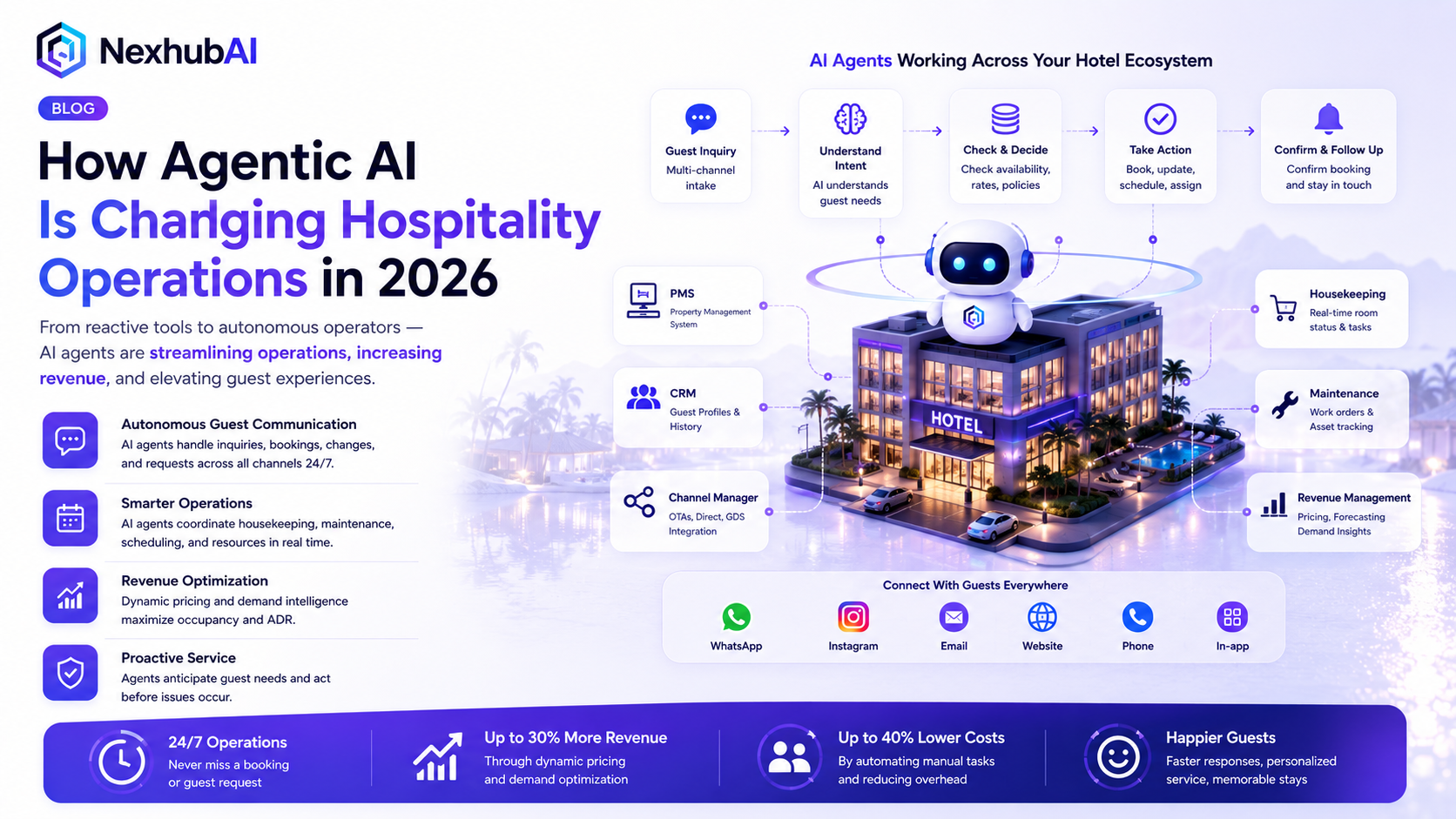
Hotels and resorts generate revenue 24 hours a day, but the operational machinery underneath that revenue has always depended on manual coordination across disconnected systems. Agentic AI is changing the underlying arithmetic, starting in the back office where the economics actually shift.
The Hospitality Industry's Operational Problem
Hotels, resorts, and short-term rental operators face an operational structure that is genuinely unusual among service businesses. Revenue is generated 24 hours a day across multiple channels. A single property simultaneously manages inbound booking inquiries, existing guest communications, housekeeping scheduling, maintenance coordination, and dynamic pricing adjustments, all requiring real-time responses and coordination across systems that rarely talk to each other natively.
For years, the industry's answer to this complexity was headcount. Enough staff at the front desk, enough coordinators in the back office, enough layers of manual oversight to catch what the systems missed. That model has a ceiling, and it shows up in the margin structure of most hospitality businesses.
Agentic AI is changing the underlying arithmetic, and the implementations that are working in 2026 are doing so quietly in the back office, not in the guest-facing lobby.
From Chatbot to Autonomous Operator
The first wave of AI in hospitality was reactive. Properties deployed chatbots that answered frequently asked questions, and most of them were barely more capable than an FAQ page with a chat interface. They required a human to step in the moment a conversation moved outside a narrow set of expected inputs.
Agentic systems operate differently. An AI agent in the hospitality context is an autonomous system that perceives guest context, reasons across connected hotel systems including the property management system, CRM, and availability data, and executes multi-step workflows end to end. It does not just answer a question. It handles the entire booking intake, checks live inventory, captures missing guest details through natural conversation, generates confirmation documents, and routes exceptions to a human only when genuinely needed.
IDC's 2026 FutureScape for Hospitality framed the shift plainly: discovery, comparison, booking, and service in travel and hospitality are increasingly being mediated by intelligent agents acting on behalf of guests. The guest does not experience this as interacting with AI. They experience it as fast, accurate, frictionless service.
Where the Real Value Is
The guest-facing AI gets the press coverage. The back-office automation is where the economics actually shift.
Dynamic pricing tied to the property management system is consistently identified as one of the highest-ROI deployments in hospitality AI. Rate adjustments that previously required a revenue manager's attention multiple times daily can be automated against real-time demand signals, competitor pricing, local event data, and occupancy forecasts. The result is not just labour savings. It is revenue capture that a manual process structurally cannot achieve at the same granularity.
Labour scheduling is the other high-impact application. Housekeeping and front-of-house staffing decisions involve forecasting occupancy, guest arrival and departure patterns, room service demand, and event overlap across weeks of bookings. AI-driven scheduling systems ingest this data continuously and produce optimized staffing plans that reduce both overstaffing costs and the service failures that come from understaffing.
Automated maintenance coordination is a downstream application that compounds over time. An agent-based system that detects anomalies from building sensors, determines whether a work order is warranted, and routes it to the appropriate maintenance team without a facilities manager manually triaging a queue is not a dramatic transformation. It is an incremental operational improvement that saves hours daily and prevents the small undetected issues that become expensive repairs.
The Architecture Problem That Limits Everything
The most common constraint on AI impact in hospitality is not the AI. It is the property management system underneath it.
Legacy PMS platforms have limited APIs, inconsistent schemas, and were built in an era when the primary expectation was storing booking data accurately, not serving as a real-time data layer for autonomous agents. When AI tools are bolted onto this foundation, the result is often duplicate guest records, broken automation workflows, and what the industry has started calling integration debt: every new tool gets harder to add than the last one because the underlying data layer is not clean.
The architectural response taking shape in 2026 has two components. First, a governed master data layer sitting above the PMS that holds the trusted version of guest, rate, loyalty, and supplier data that every AI tool reads from. Second, protocols like MCP that allow agent-to-agent communication without requiring a custom connector for every integration.
Properties that have invested in clean data architecture and open API infrastructure are extracting significantly more value from AI deployments than those running the same tools on fragmented legacy systems. The technology is not the bottleneck. The plumbing is.
Proactive Service as the Next Frontier
The highest-value evolution in agentic hospitality AI is not smarter responses. It is proactive action that eliminates the need for a response.
An agent that detects an arriving guest's inbound flight has been delayed, automatically adjusts room preparation timing, notifies the dining team, updates the arrival schedule, and sends the guest a personalised message acknowledging the delay, without any human triggering the sequence, is not responding to a request. It is removing a problem that should never have needed the guest's attention in the first place.
Gartner identifies this shift from reactive to proactive as the primary differentiator between first-generation hotel automation and genuinely agentic systems. Most properties are still at the reactive stage. The ones building proactive architectures now are creating service experiences that competitors running manual processes cannot replicate at scale.
What This Means for Staffing
One of the persistent concerns in this conversation is that AI automation in hospitality means staff reductions. The data from 2026 deployments tells a more nuanced story.
Automation frees front-line teams from transactional duties: answering the same booking questions repeatedly, manually updating records, chasing maintenance status, triaging inbound messages across channels. What it does not remove is the judgment, warmth, and situational awareness that make a guest experience genuinely memorable. In higher-end properties particularly, the competitive advantage of exceptional human service becomes more pronounced when the operational infrastructure around that service runs automatically.
The hotels winning with AI in 2026 are the ones that have used automation to give their teams more capacity for the interactions that actually matter to guests, not fewer staff to handle more volume.
---
NexhubAI builds agentic systems for hospitality operators, covering booking automation, guest communication pipelines, and multi-channel engagement across WhatsApp, Instagram, and direct channels. [Get in touch](https://nexhubai.com/contact) to discuss what an agentic layer could do for your property.
Start with your requirements
Our AI assessment identifies your highest-value automation opportunities in 30 minutes.
Free Assessment