
A Practical Guide to AI Automation for Service Businesses
Abid Hussain · 8 min read ·
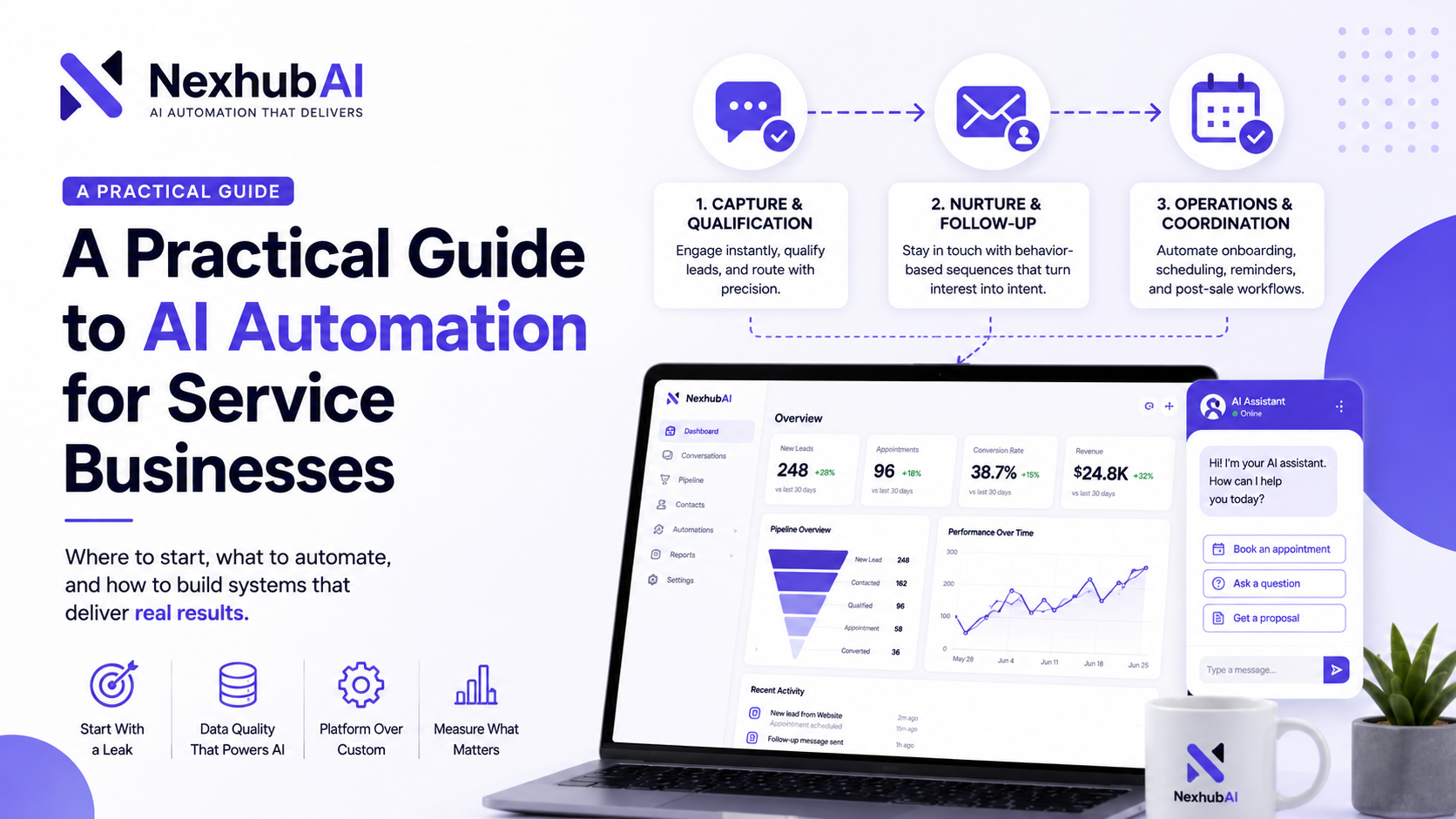
The question of whether to use AI automation is settled. The harder questions are which workflows to automate first, how to avoid implementation mistakes that consume budget without delivering results, and what separates systems that work reliably from ones that impress in demos and break in production.
The Question Has Changed
A year ago, the question most business owners were asking about AI was whether to use it. That question is effectively settled. The harder question now is where to start, which workflows to automate first, and how to avoid the implementation mistakes that turn promising AI projects into expensive disappointments.
The answers are not the same for every business. A five-person agency and a 500-person enterprise have different constraints, different risk tolerances, and different workflows that justify automation. But the principles that separate implementations that produce measurable results from the ones that consume budget without impact are consistent.
This is a practical guide to those principles, written for operators rather than engineers.
Start With a Leak, Not a Wish List
The instinct when approaching AI automation is to build a comprehensive list of everything the business could automate and then try to address all of it. This produces sprawling projects with unclear success criteria and no way to know whether anything is working.
A more reliable starting point is identifying where the business is currently losing money, time, or customers through a specific, quantifiable operational failure.
In most service businesses, the highest-value leaks are predictable. Lead response time is one of the most documented: research consistently shows that response within five minutes converts at dramatically higher rates than response after 30 minutes, and most businesses respond much later than five minutes on average. Customer follow-up sequences that depend entirely on a person remembering to send a message create systematic holes in the pipeline. Appointment scheduling that requires back-and-forth coordination over multiple messages adds unnecessary friction and no-show risk at every step.
These are not glamorous problems. But they are quantifiable, and fixing them with automation produces results that can be measured against a clear before-state.
The Three-Layer Architecture That Works
Production AI automation for service businesses that works reliably tends to follow a consistent three-layer structure.
The first layer is capture and qualification. An AI agent handles initial inbound contact across all channels, whether web chat, SMS, social DMs, or phone, and engages the prospect immediately. It asks qualifying questions, captures the information needed to route or prioritize the lead, and either continues the conversation autonomously or escalates to a human based on defined criteria. This layer addresses the response-time problem and ensures no lead goes unacknowledged.
The second layer is nurture and follow-up. Leads that are not ready to convert immediately enter automated sequences that stay in contact based on behavior rather than fixed schedules. If a prospect views a specific page, they receive relevant follow-up. If they go silent for a set number of days, a re-engagement sequence triggers. If they respond at any point, the conversation context carries forward. This layer ensures that long-cycle prospects do not simply age out of the pipeline because nobody was tracking them manually.
The third layer is operations and coordination. Once a lead converts, the same infrastructure that handled acquisition handles onboarding, scheduling, reminders, document collection, and feedback. The handoff from sale to delivery is automated, not dependent on someone remembering to send the right message at the right time.
Each layer has discrete success metrics. Each can be implemented and evaluated independently. Together they form a system that handles the full customer lifecycle without requiring a human to manage every interaction.
The Data Problem Nobody Mentions Early Enough
The most common constraint on AI automation is not the tools. It is the quality of the data the tools have to work with.
An AI agent that qualifies leads based on behavioral signals can only do so if those signals are being captured cleanly. A follow-up sequence that personalizes based on contact history requires contact history that is accurate and consistently structured. A pipeline that routes leads based on source performance needs source attribution that actually works.
In most businesses, the data layer has grown organically and inconsistently. Contacts were imported from multiple sources with different field structures. Some records are duplicates. Source attribution was not tracked from the beginning. Tags and categories were created ad hoc and are not consistently applied.
The AI automation will perform proportionally to the quality of the data underneath it. Cleaning and structuring the data layer before building automation on top of it is the step that most projects skip in the interest of speed, and it is the single most common reason implementations underdeliver.
When to Build Custom vs When to Use Platforms
The question of whether to build custom automation infrastructure or deploy on a platform like GoHighLevel, HubSpot, or a comparable system is one that comes up in almost every implementation conversation.
For most service businesses and agencies, the answer tilts strongly toward platform. Purpose-built automation platforms have invested years of engineering into the reliability, integration breadth, and edge case handling that custom solutions would need to rebuild from scratch. The economics of building a custom SMS delivery system, a custom calendar integration, and a custom email deliverability infrastructure are not favorable compared to accessing all of it through a subscription.
The cases where custom development is justified are specific. When a business has a genuinely unique workflow that no platform handles adequately. When the data processing requirements are complex enough that platform limitations create meaningful constraints. When the business model involves reselling the system to clients who need something that looks proprietary.
Outside of those situations, the better investment is usually in deep configuration of a capable platform rather than shallow custom development. A properly configured platform that handles the core workflows reliably beats a custom system that handles them inconsistently.
Measuring Whether It's Working
Production AI automation should be evaluated against the same metrics any business operation is evaluated against, not against AI-specific benchmarks that do not connect to business outcomes.
For lead capture and qualification: contact-to-appointment conversion rate, average response time, lead volume that makes it to the pipeline versus total inquiries. For nurture sequences: re-engagement rate on inactive leads, sequence completion rates, response rates across channels. For operational automation: no-show rates, time from sale to onboarding completion, customer satisfaction on the post-sale experience.
If these metrics are not improving measurably within 60 to 90 days of implementation, the issue is almost always in one of three places: the data quality underneath the automation, a workflow design that does not match how customers actually behave, or success criteria that were never defined clearly enough to evaluate against.
The answer is not to add more automation. It is to go back to the specific failure point and fix it before expanding.
---
NexhubAI builds and configures AI automation systems for service businesses, agencies, and operators who want their infrastructure to run reliably without requiring a team to manage it manually. [Get in touch](https://nexhubai.com/contact) to talk through what an implementation would look like for your business.
Start with your requirements
Our AI assessment identifies your highest-value automation opportunities in 30 minutes.
Free Assessment