
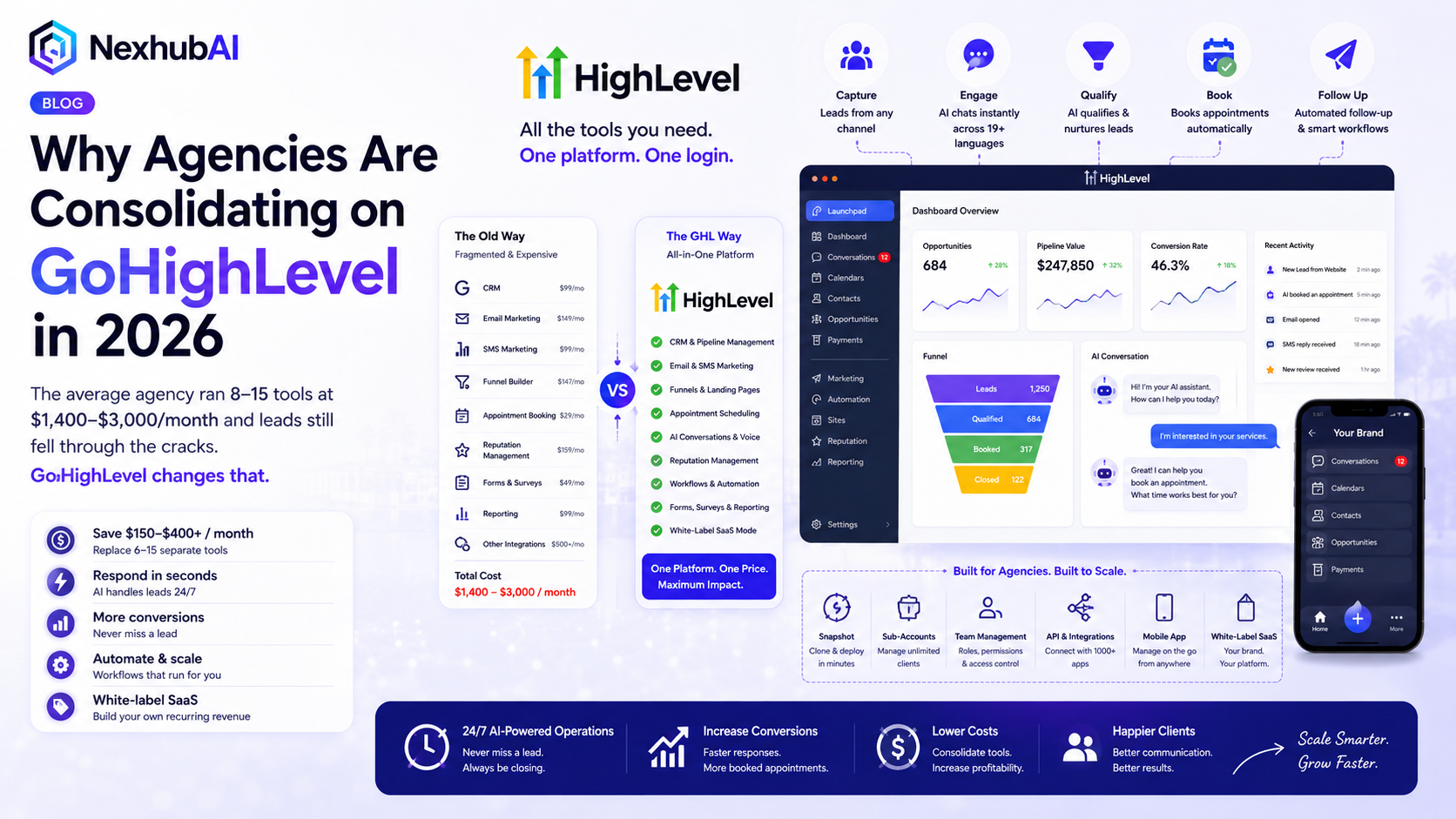
The average agency in 2025 ran between 8 and 15 separate SaaS tools at a combined cost of $1,400 to $3,000 per month, and leads still fell through the cracks. GoHighLevel's consolidation model and AI-native automation layer are why agencies are making the switch at scale in 2026.
The Invisible Cost of a Fragmented Tech Stack
Most agencies and service businesses hit the same wall eventually. There is a CRM for contacts, a separate tool for email marketing, another for SMS, a booking calendar that doesn't sync cleanly with anything, a funnel builder that lives in its own silo, and a reputation management tool that requires yet another login. Each one has its own billing cycle. None of them share data natively. A lead comes in, gets entered manually into the CRM, triggers an email from one platform, a text from another, and somehow has to be manually linked to a calendar booking that exists in a third system.
The combined monthly cost of this stack for an average US agency in 2025 ran between $1,400 and $3,000. And the leads still fell through the cracks because none of these tools talked to each other reliably.
This is the specific problem GoHighLevel was built to solve, and in 2026, it has become the platform that agencies and local service businesses are consolidating onto at a significant rate.
What GHL Actually Is
GoHighLevel is not a CRM with some extra features bolted on. It is a full business operating platform that replaces six to fifteen separate tools inside a single subscription. The core includes CRM and contact management, email and SMS marketing automation, a funnel and landing page builder, appointment scheduling with automated reminders, AI-powered conversation and voice agents, reputation management, and white-label SaaS mode for agencies that want to resell the platform under their own brand.
Since its founding in 2018, GHL has grown to power over 1.4 million businesses worldwide. The 2025 and 2026 platform updates were not incremental. They rebuilt the automation layer around AI from the ground up.
Conversation AI now handles inbound SMS, web chat, and social DMs across 19 languages, qualifying leads, answering objections, and booking appointments without a human in the loop. Voice AI supports inbound and outbound calling. The Workflow AI Assistant builds and refines automation sequences directly from natural language instructions. Content AI generates email copy, SMS sequences, and follow-up scripts inside the builder itself.
For the agencies that configure these systems properly, the platform effectively operates as an AI-powered sales and operations team running 24 hours a day.
The Lead Response Problem, Solved
Speed-to-lead is one of the most consistently validated competitive advantages across service businesses. An inquiry that gets a response within five minutes converts at a dramatically higher rate than one that waits 30. In most businesses, that five-minute window closes because the owner or agent is occupied with existing clients, or simply offline.
GHL's Conversation AI closes that gap permanently. When a prospect messages through any channel, an AI agent engages immediately, asks qualifying questions in natural language, consults a custom knowledge base to answer product and pricing questions accurately, and books an appointment directly into the calendar. The business owner gets a notification that a qualified appointment has been booked, without having had to be present for any part of the initial conversation.
The practical impact is that a well-configured GHL account functions as a 24/7 inside sales operation, regardless of the size of the team running it.
Workflows That Actually Change Unit Economics
The automation layer in GHL goes well beyond simple email sequences. The if/else logic inside workflows means the follow-up behaves differently depending on how a contact responds. A lead who replies gets a different path than one who goes silent. A lead who books a call exits the nurture sequence entirely and enters an appointment reminder sequence. A contact who doesn't show gets an automated re-engagement flow.
For agencies managing multiple clients across similar niches, GHL's Snapshot system is a significant operational multiplier. A snapshot packages an entire account configuration including workflows, pipelines, funnels, and automation templates, and deploys it to a new client sub-account in minutes. A system built once for the dental niche, for example, deploys to every dental client in the portfolio without rebuilding from scratch. That directly compresses the time between signing a client and having their system operational.
The SaaS Mode Angle
For agencies that want to move beyond trading time for money, GHL's SaaS Mode is the structural mechanism. It allows agencies to white-label the entire platform under their own brand, set their own pricing tiers, and resell it to clients as proprietary software. The platform, the mobile app, and the client-facing interface all carry the agency's branding with no GoHighLevel mention visible.
The business model shift this enables is significant. Instead of charging clients a service retainer for manual work, an agency can charge a monthly SaaS fee for access to a platform that handles the ongoing automation automatically. Service revenue and recurring SaaS revenue become two separate revenue lines from the same client.
Experienced agency owners moving their entire client base onto GHL in 2026 describe this as the most important structural change they have made to their business model.
What It Is Not
GHL is not the right tool for every situation and it is worth being direct about this. The platform has a steep learning curve. Configuring it properly to extract full value requires either significant time investment or a specialist. Out of the box it is a complex system, and businesses that simply sign up and expect results without configuration will be disappointed.
The AI features are also not included in the base plan price. Conversation AI, Voice AI, and Content AI operate on pay-as-you-go pricing or as add-on subscriptions per sub-account. For agencies planning to deploy these features at scale, the AI costs need to be factored into client pricing models.
And for large enterprises with deep Salesforce or HubSpot integrations, complex reporting requirements, and dedicated CRM administrators, GHL is not a substitute. It was built for agencies and service businesses, and it excels in that context.
The Consolidation Case
For the right type of business, the consolidation argument is straightforward. An agency replacing separate tools for CRM, email marketing, SMS, calendar booking, funnel building, and review management saves $150 to $400 per month in software costs while gaining tighter integrations, a unified contact record, and a single system to learn and maintain.
The AI additions in 2025 and 2026 change the calculus further. The platform now handles functions that previously required custom development or separate vendor relationships. Businesses that configure these systems properly are not just saving on tools. They are replacing labor costs with automated workflows that operate continuously without human oversight.
That is the actual case for GHL in 2026: not that it is the most sophisticated platform in any individual category, but that it is the most capable consolidated system for agencies and service businesses that want to operate with a lean team and compete at a level that previously required a much larger one.
---
NexhubAI specializes in GoHighLevel implementation and AI workflow automation for agencies and service businesses. If you want a system that runs leads through qualification and booking automatically, [get in touch](https://nexhubai.com/contact).
Start with your requirements
Our AI assessment identifies your highest-value automation opportunities in 30 minutes.
Free Assessment