
Why Your LLM Works in the Demo and Breaks in Production
Abid Hussain · 6 min read ·
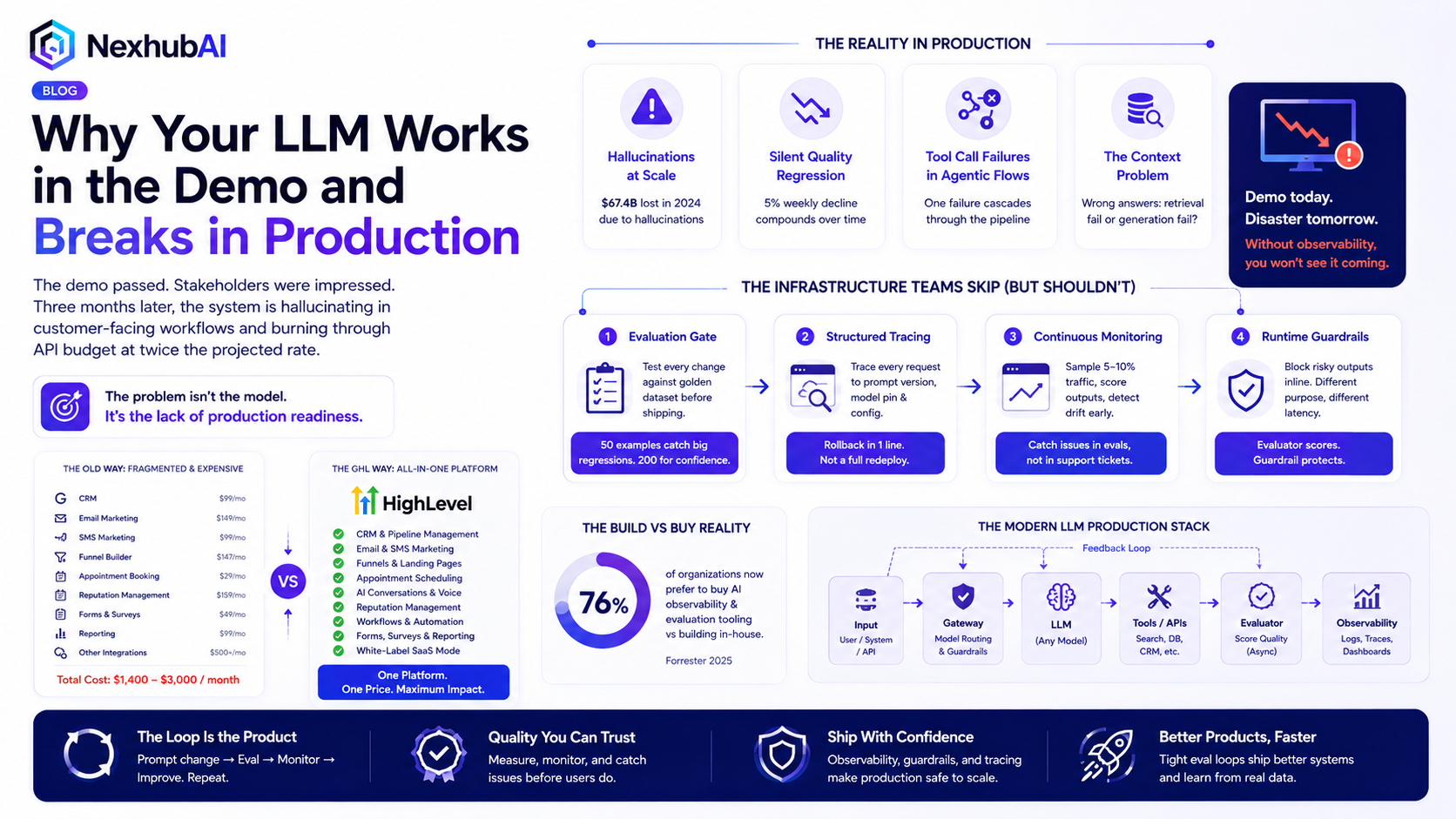
The demo passed. Stakeholders were impressed. Three months later, the system is hallucinating in customer-facing workflows and burning through API budget at twice the projected rate. This is not a rare story. It is the default outcome for teams that treat production readiness as an afterthought.
The Demo Is Not a Measurement
There is a version of this story that plays out repeatedly in AI projects. The prototype works beautifully in a controlled setting. It handles edge cases gracefully, answers questions smoothly, and impresses every stakeholder in the room. Then it ships to production. Three months later, the system is hallucinating in customer-facing workflows, the legal team has flagged several confident wrong answers, and the platform engineers are too nervous to push any prompt changes because nobody knows what the last update actually changed.
The problem was never the model. It was the absence of any infrastructure for measuring whether the model was behaving correctly before and after it touched real users.
Shipping a working prototype takes an afternoon. Shipping the same workflow as a reliable, observable, audited production system takes a quarter. That gap is where most LLM projects quietly fail.
What Actually Goes Wrong
Production LLM failures cluster into a predictable set of categories. Understanding them is the first step toward building systems that catch them before users do.
Hallucinations at scale. LLM hallucinations cost businesses an estimated $67.4 billion in 2024. In a demo, one wrong answer is a curiosity. In a production system handling thousands of interactions daily, confident wrong answers in customer-facing or regulated workflows are not acceptable as occasional bugs. They are liability.
Silent quality regression. A model that performs well on day one does not necessarily perform well on day sixty. Input distributions shift as new user segments arrive. Model providers update weights without changing the API identifier. A 5% weekly quality decline is invisible without continuous monitoring, but it accumulates. Six weeks later you have a significantly degraded system that nobody noticed degrading.
Tool call failures in agentic flows. When LLMs are wired into multi-step agentic workflows, the failure modes compound. One agent's hallucinated output becomes the next agent's ground truth. A tool call that fails silently cascades through the pipeline. Tool failures in agentic flows often cause more user-visible damage than model quality drops, and most monitoring setups are not designed to catch them at the trajectory level.
The context problem. When a production RAG system gives a wrong answer, there are two entirely different possible causes: the retrieval layer pulled irrelevant documents, or the model generated a response that ignored the correct documents it was given. Without structured tracing, you cannot tell which one failed. You cannot fix what you cannot see.
The Infrastructure Teams Skip
The teams that avoid these failure modes share one discipline: they treat production readiness as a Phase 0 requirement rather than something to retrofit after the demo gets approved.
In practice this means four things.
A reproducible evaluation gate. Every prompt change and model swap should be tested against a frozen golden dataset of real production examples before anything ships. Not MMLU benchmark scores, which tell you almost nothing about application-level performance, but your actual task distribution with human-verified expected outputs. Research suggests 50 examples catches large regressions; 200 examples gives statistical confidence on smaller quality differences.
Structured tracing. Every production request should be traceable back to a specific prompt version, model pin, and pipeline configuration. When something breaks, the rollback should be a one-line config change at the gateway, not a full code redeploy while users are experiencing the failure.
Continuous production monitoring. Sampling 5 to 10% of real traffic, scoring it with an automated evaluator, and watching for drift is the only layer that catches changes that happen to you rather than changes you make. This is not optional. It is the difference between learning about regressions from your eval pipeline and learning about them from customer support tickets.
Runtime guardrails, separate from evaluation. An evaluator scores output quality asynchronously after the fact. A guardrail blocks a specific failure mode inline with millisecond latency requirements. Both are necessary. Conflating them produces systems that are slow in the wrong places and blind in the others.
The Build vs Buy Reality
A Forrester 2025 report found that 76% of organizations now prefer to purchase AI observability and evaluation tooling versus building it in-house, up from 47% the previous year. The shift reflects hard experience: the hidden costs of building observability, evaluation pipelines, and compliance automation from scratch consistently exceed the cost of commercial platforms.
The practical architecture that mature enterprise stacks converge on is not a surprise: buy observability and evaluation tooling, build orchestration logic and domain-specific guardrails, keep the model selection layer provider-agnostic through a gateway abstraction. Buy the horizontal infrastructure; build the vertical intelligence.
The Loop Is the Product
The lever in production LLMs in 2026 is no longer parameter count. Frontier APIs are cheap enough that model quality is rarely the constraint. The real differentiator is the eval loop: the cycle from prompt change to evaluation gate to traced production traffic to scored regression detection back to the next prompt change.
Teams that run this loop tightly ship better products. Teams that skip it keep getting surprised by the same categories of failure. The model did not break. The system around the model was never built.
---
NexhubAI builds production-grade LLM pipelines and agentic systems with observability and evaluation baked in from day one. If your AI project is stuck between demo and production.
Start with your requirements
Our AI assessment identifies your highest-value automation opportunities in 30 minutes.
Free Assessment