
Multi-Agent AI Is Redefining How Enterprises Operate in 2026
Abid Hussain · 7 min read ·
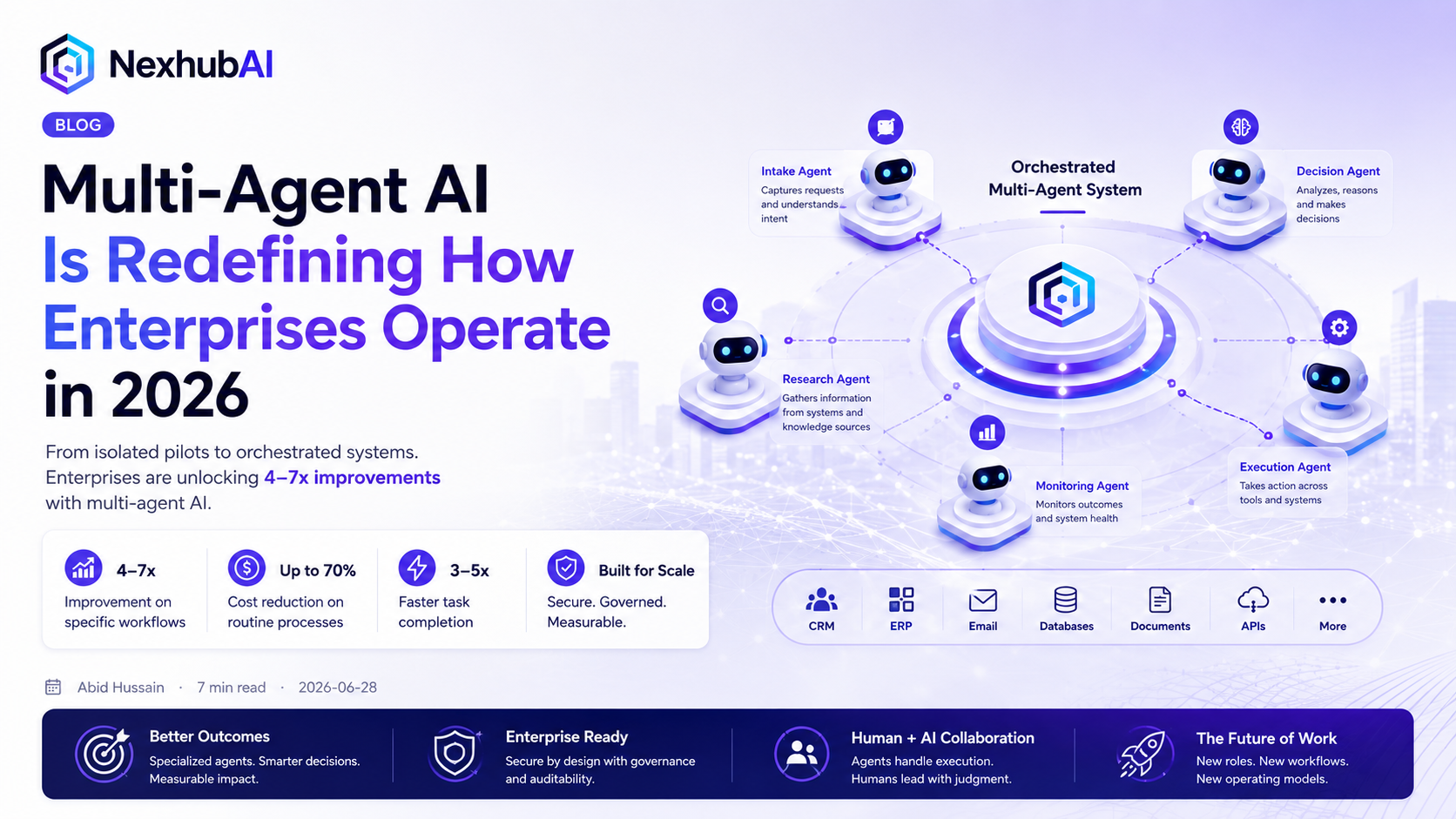
The era of isolated AI pilots that impress in demos but fail to scale is giving way to multi-agent architectures that orchestrate entire business processes end to end. In 2026, enterprises that get this transition right are seeing 4 to 7x improvements on specific workflows. The ones that get it wrong are stuck in perpetual proof-of-concept purgatory.
The Era of Isolated Pilots Is Over
For the past few years, enterprise AI adoption followed a familiar pattern. A team identified a use case, ran a proof of concept, got a promising demo, and then struggled to scale the results into something that meaningfully changed how the business operated. The AI sat adjacent to the workflow rather than inside it. It helped people think faster but did not change what actually got done.
That pattern is breaking down in 2026, driven by the maturation of multi-agent architectures that can orchestrate entire business processes rather than assist with individual tasks.
Gartner projects that 40% of enterprise applications will embed AI agents by the end of 2026, up from less than 5% in 2025. The acceleration is not driven by hype. It is driven by enterprises that ran the first generation of isolated pilots, understood what did not work, and are now redesigning workflows from the ground up.
What Multi-Agent Means in Practice
A single AI agent is useful. It can handle a specific task, reason about inputs, use tools, and execute a defined sequence of actions. The constraint is that complex business processes are not single tasks. They are sequences of interdependent tasks that span multiple systems, require different types of reasoning at different stages, and need to adapt when conditions change midstream.
Multi-agent systems address this by breaking complex processes into modular steps handled by specialized agents that collaborate and hand off context to each other. Instead of one general-purpose agent attempting to manage everything, you have an orchestrated team: an intake agent, a research agent, a decision agent, an execution agent, a monitoring agent. Each one is good at its specific role, and the system as a whole handles the end-to-end process.
This architecture produces better outcomes than single-agent approaches for the same reason that specialized human teams outperform generalists on complex work. And the operational scale it enables is qualitatively different from what traditional automation could achieve. In healthcare, agentic systems are handling 87% of patient service interactions end to end, from identity verification through appointment scheduling. In HR and IT, that figure reaches 93%, absorbing peak demand before it ever reaches the service desk.
The Business Case Is Now Measurable
The multi-agent AI market is projected to grow at a 48.5% compound annual rate through 2030. That growth reflects something more concrete than investor enthusiasm: enterprises reporting measurable results from agentic deployments.
Teams adopting multi-agent architectures are reporting 4 to 7x improvements in conversion rates on specific workflows, cost reductions approaching 70% on routine operational processes, and task completion speeds that are 3 to 5 times faster than equivalent human workflows. These are not averages across all AI deployments. They are results from deployments that were architected correctly, with the right domain selection, data infrastructure, and governance in place.
The deployments that underperform tend to share a common characteristic: they were treated as technology purchases rather than workflow redesigns. An agent layered onto a broken process produces a faster broken process. The value comes from redesigning the process around agentic execution, not from adding an agent to an existing sequence and hoping it compensates for structural inefficiencies.
The Governance Gap That Limits Scale
The most underestimated risk in enterprise multi-agent adoption is governance. As agents move from assistive tools to autonomous operators executing actions across business-critical systems, the question of who is accountable for what an agent does becomes operationally significant.
Recent research suggests 88% of organizations have experienced AI-related security incidents, yet only around 22% treat AI agents as identity-bearing entities with formal access controls. That mismatch compounds in multi-agent environments. When an agent is authorized to call tools, write to databases, and trigger downstream workflows, poorly governed systems can produce mistakes that scale faster than any human error could.
The organizations that are scaling multi-agent systems successfully are building governance as part of the architecture from the beginning, not retrofitting it after deployment. This means clear authorization boundaries for each agent, audit trails that trace every action back to an identifiable decision point, human escalation paths for exceptions that fall outside defined parameters, and evaluation infrastructure that monitors behavior continuously rather than only at launch.
Where to Start
The practical entry point for most enterprises is identifying a single domain with the right properties: high transaction volume, repetitive decision patterns, clear success metrics, and sufficient data history to evaluate agent behavior against expected outcomes.
Customer service, IT helpdesk, HR request handling, and procurement approval workflows consistently appear as the earliest and highest-ROI multi-agent deployments because they meet all of these criteria. They involve large volumes of standardized interactions, have well-defined resolution paths, and have historical data that makes evaluation tractable.
Starting broad with ambitious cross-functional automation is the pattern that produces 40% of multi-agent projects failing due to inadequate foundations. Starting narrow with one domain, building the data and governance infrastructure properly, measuring results rigorously, and expanding incrementally is the pattern that produces compounding value.
The Operating Model Is Changing
The deeper implication of multi-agent enterprise AI is not productivity improvement on existing processes. It is a structural change in how enterprises staff and organize work.
When agentic systems handle the execution layer of high-volume operational processes, the human role shifts toward oversight, exception handling, and decisions that require judgment, context, or accountability that autonomous systems are not suited for. New roles are emerging: agent orchestrators who manage multi-agent handoffs and performance, AI security engineers focused on adversarial testing, interaction designers who refine how humans and agents collaborate within shared workflows.
The 78% of executives in UiPath's 2026 Automation Trends Report who said they would need to reinvent their operating models to capture agentic AI's full value are not describing a distant future. They are describing the transition that is already underway in the organizations running ahead of them.
---
NexhubAI designs and deploys multi-agent AI systems for enterprise clients across real estate, commerce, and hospitality. If you are evaluating how to move from isolated pilots to production-grade agentic infrastructure, [get in touch](https://nexhubai.com/contact).
Start with your requirements
Our AI assessment identifies your highest-value automation opportunities in 30 minutes.
Free Assessment