
Why RAG Is the Architecture Every Business AI Actually Needs
Abid Hussain · 7 min read ·
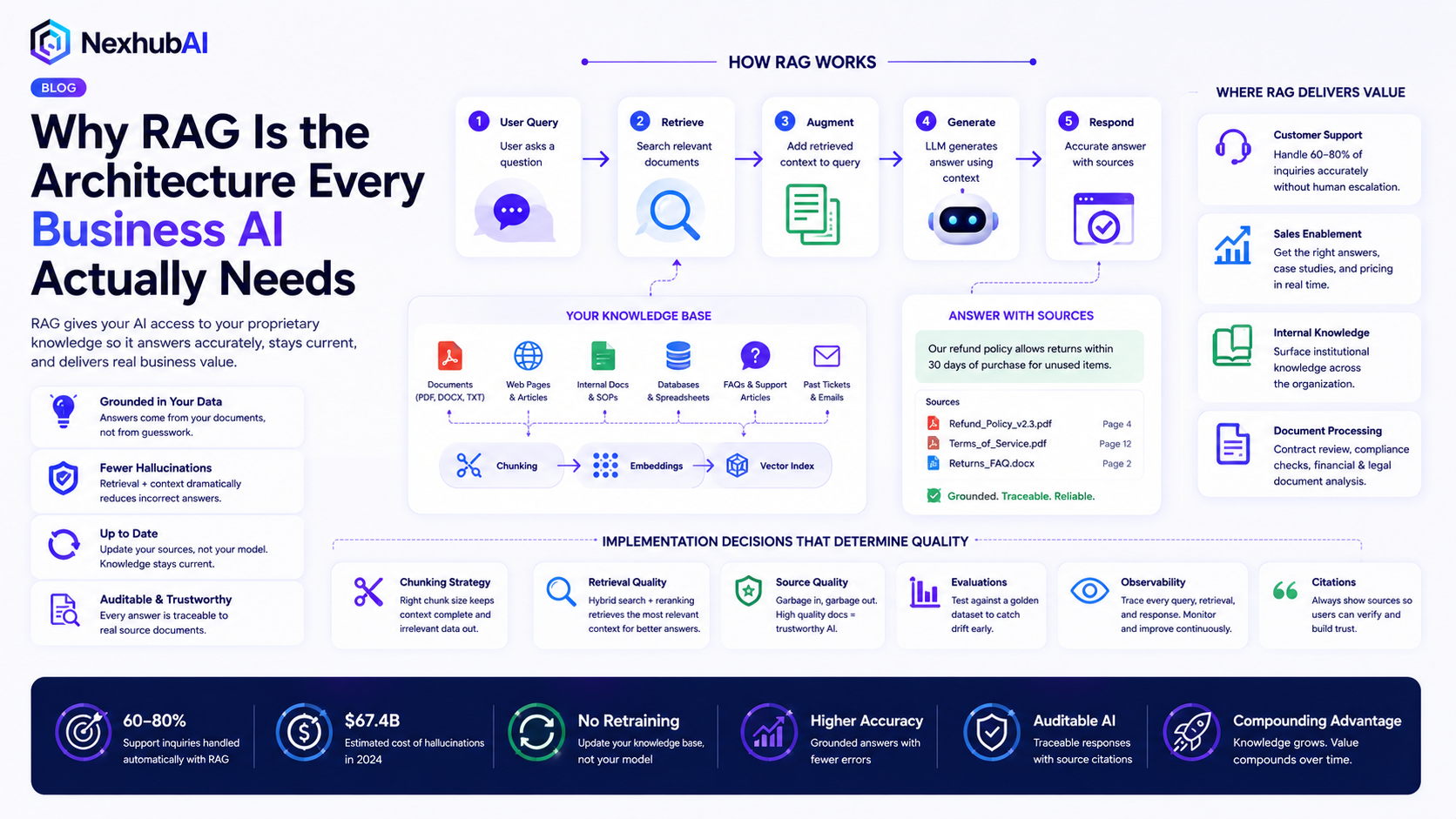
Every business has proprietary knowledge that no AI model was trained on. Pricing structures, product specs, internal processes, client history. When AI systems answer without access to this, they hallucinate or deflect. Retrieval-Augmented Generation is the architectural pattern that closes this gap, and in 2026 it is the standard approach for any enterprise AI that needs to be accurate about something specific.
The Problem with What Your AI Doesn't Know
Every business has proprietary knowledge that lives outside any AI model's training data. Your pricing structure. Your product specifications. Your internal processes. Your compliance requirements. The institutional knowledge your best employees carry. Your client history going back years.
When you build an AI system without a retrieval layer, that knowledge stays invisible to it. The model answers from its general training, which means it either guesses, hallucinates a plausible-sounding answer, or admits it does not know and sends the user somewhere else. None of these outcomes are what you built the system for.
Retrieval-Augmented Generation, known as RAG, is the architectural pattern that solves this. It is the difference between an AI that knows about the world in general and one that knows about your business specifically. In 2026, it has moved from an advanced technique discussed in research papers to the standard architecture for any enterprise AI system that needs to answer questions accurately against a specific body of knowledge.
What RAG Actually Does
The core mechanism is straightforward even if the implementation has meaningful depth. When a user submits a query, instead of the language model generating an answer from its training weights alone, the system first searches a connected knowledge base for the most relevant documents, extracts the relevant passages, and hands both the original query and the retrieved context to the model. The model then generates a response grounded in that retrieved material rather than in general training data.
The analogy that holds up: a lawyer answering a contract question does not rely purely on memory. They check the relevant case files, review the specific clause, and answer based on the actual document in front of them. RAG gives an AI system the same capability: the ability to consult the right source material before responding.
This architecture solves several problems simultaneously. Hallucination rates drop significantly because the model is generating answers from retrieved evidence rather than inference. Responses stay current without retraining because you update the knowledge base rather than the model. Answers become auditable because the retrieved source documents can be surfaced alongside the response. And domain-specific accuracy improves because the model is working with your actual data rather than general approximations.
Where Businesses Are Getting Measurable Value
Customer support is the most common first deployment, and for good reason. A support AI trained on a company's documentation, past ticket resolutions, product specifications, and policy documents handles the questions it was built for accurately and consistently, without the hallucination risk that comes from a model answering from general knowledge. Well-configured RAG systems handle 60 to 80% of inbound support inquiries without human escalation, with the remaining volume routed to agents with full conversation context already captured.
Sales enablement is the adjacent high-value use case. Sales teams operate with fragmented information: product sheets in one place, pricing in another, case studies scattered across a shared drive, competitive intelligence buried in email threads. A RAG-powered internal assistant that retrieves the right material on demand lets a salesperson answer a prospect's specific technical question accurately during a call, rather than promising to follow up, which rarely converts as well.
Internal knowledge management is where the compounding value becomes clearest over time. Most organizations have significant institutional knowledge that lives only in the heads of senior employees, in documentation nobody has updated in three years, or in email threads that are technically searchable but practically impossible to navigate. A RAG system ingesting active documentation, process guides, past project files, and institutional memory creates a retrieval surface that makes that knowledge genuinely accessible for the first time.
Document processing is the operational application. Contract review, compliance checking, financial document analysis, and regulatory lookup tasks that involve finding specific information across large volumes of structured and unstructured documents are natural RAG use cases. Rather than a human manually searching through hundreds of pages, an AI retrieves the relevant clause, section, or data point and surfaces it with the source citation attached.
Why This Is Architecturally Better than Fine-Tuning for Most Business Use Cases
Fine-tuning, the process of retraining a model on domain-specific data to make it more knowledgeable about a subject, is still the right tool for some problems, specifically for changing how a model behaves or reasons rather than what it knows. But for the majority of business knowledge problems, RAG is the better architecture for a clear reason: knowledge changes.
When you fine-tune a model on your product catalog, that knowledge is baked into the model weights. When your catalog updates, you retrain. When prices change, you retrain. When a product is discontinued, you retrain. The operational overhead compounds with every update cycle.
With RAG, you update the knowledge base. The document changes, the vector index updates, and the AI's answers reflect the new information the next time it retrieves from that source. No retraining, no deployment, no lag between the knowledge update and the system reflecting it.
For business data that changes regularly, which is most business data, RAG's update model is structurally more practical than fine-tuning's.
The Implementation Decisions That Determine Quality
The gap between a RAG system that works and one that produces unreliable results is almost always in the implementation details rather than the model choice.
Chunking strategy matters more than most teams expect. How documents are split into retrievable segments directly affects whether the retrieved context is coherent. Too-large chunks include irrelevant material that dilutes the answer. Too-small chunks lose context that the model needs to answer accurately. The right chunking approach is document-type specific and requires testing against real queries.
Retrieval quality is the variable with the highest leverage on overall system performance. Semantic search using vector embeddings retrieves conceptually related content even when the exact terms differ. Keyword search retrieves exact matches efficiently. Hybrid approaches combining both outperform either alone for most enterprise use cases, and adding a reranking step that scores retrieved chunks by relevance to the specific query before passing them to the model measurably improves answer quality.
The quality of the source documents is the factor that most implementations underestimate. A RAG system grounded in accurate, well-structured, current documentation produces accurate answers. A RAG system grounded in outdated, inconsistently formatted, or incomplete documentation produces answers that reflect those problems. The garbage-in principle applies directly. Investing in documentation quality before building the retrieval layer is not a nice-to-have. It is what determines whether the system is trustworthy.
What a Deployed System Actually Needs
Beyond the retrieval pipeline itself, production RAG deployments require the same observability infrastructure as any other LLM system. Structured traces that capture what was retrieved for each query, what the model generated in response, and what the user's follow-up behavior was. Evaluation against a golden dataset of question-answer pairs specific to your domain, run regularly to detect drift. Source citation surfaced to the user so responses can be verified rather than trusted blindly.
The citation requirement is particularly important in business contexts. An AI that tells a support agent that a customer is entitled to a refund based on a specific policy should show which policy clause it retrieved that from. An AI that answers a contract question should surface the exact clause. Without source attribution, a RAG system is difficult to audit and difficult to trust at the level that enterprise use cases require.
The Compounding Advantage
The strategic case for RAG goes beyond making a single AI system more accurate. It is about building an organizational knowledge infrastructure that improves over time.
As a knowledge base grows and is maintained well, the retrieval system surfaces answers to questions that previously required finding the right person and scheduling a call. New employees can access institutional knowledge that previously lived only with senior colleagues. Edge cases that required manual research become retrievable. The cost of knowledge-intensive work per unit declines as the retrieval surface expands.
This is the investment thesis for RAG that extends beyond any individual deployment: it turns documentation from a static archive that nobody reads into an active operational asset that the AI can query on behalf of anyone who needs it.
---
NexhubAI designs and builds RAG pipelines for businesses that need their AI to answer accurately against their own knowledge, not guess from general training data. [Get in touch](https://nexhubai.com/contact) to discuss what a knowledge-grounded AI system would look like for your use case.
Start with your requirements
Our AI assessment identifies your highest-value automation opportunities in 30 minutes.
Free Assessment