
WhatsApp Is Now a $45 Billion Commerce Channel. Most Businesses Are Still Using It Like a Chat App.
Abid Hussain · 7 min read ·
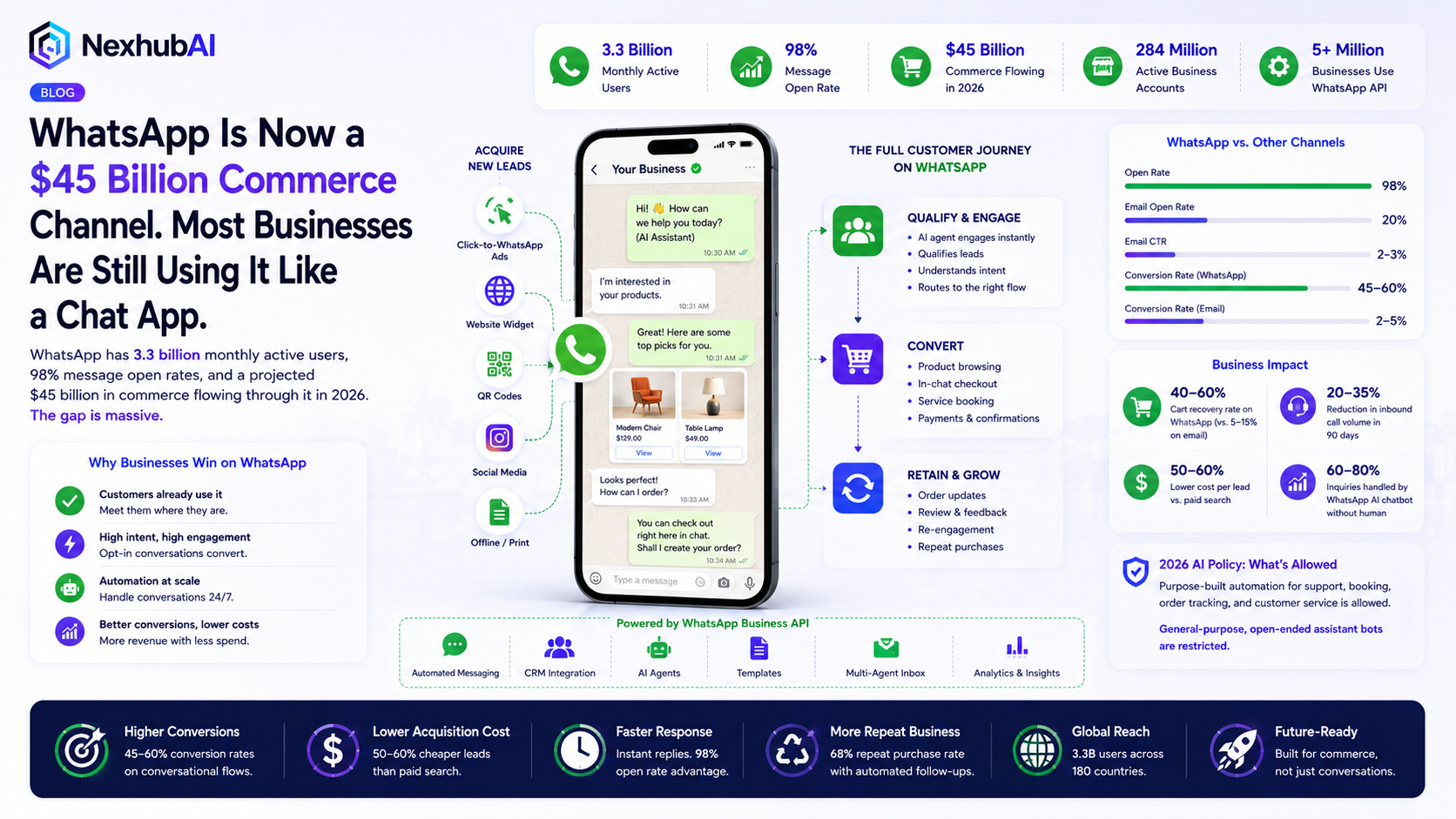
WhatsApp has 3.3 billion monthly active users, 98% message open rates, and a projected $45 billion in commerce flowing through it in 2026. Most businesses are still using it to send PDFs and answer the same five questions manually. The gap between how WhatsApp is being used and what it can actually do for revenue is significant.
The Channel Most Businesses Are Getting Wrong
Email open rates hover around 20% on a good day. Paid social click-through rates are in the low single digits. WhatsApp delivers 98% open rates, and businesses with properly configured automation are seeing conversion rates between 45% and 60% on conversational flows.
Those numbers are not from a vendor pitch deck. They reflect what happens when a customer is already in their most-used app, receiving a message they opted into, at a moment when they are ready to engage.
By 2026, WhatsApp has grown to 3.3 billion monthly active users across 180 countries. An estimated $45 billion in global commerce is projected to flow through the platform this year. Active WhatsApp Business accounts reached 284 million, up 42% from the prior year, and over 5 million businesses globally now use the WhatsApp Business API for automation and integration at scale.
Most of them are still using it wrong.
The Difference Between WhatsApp as a Messaging App and WhatsApp as a Revenue Channel
The businesses treating WhatsApp as a support inbox are capturing a fraction of its value. A customer messages asking about their order status. A human responds hours later. The conversation closes. That is the most common WhatsApp business implementation in 2026, and it misses almost everything the platform can do.
The businesses generating real revenue from WhatsApp have rebuilt their customer journey around conversational flows that handle the full cycle: acquisition through Click-to-WhatsApp ads, qualification through AI-powered conversation, purchase through in-chat checkout, retention through behaviorally triggered follow-ups, and cart recovery through timed re-engagement.
Cart abandonment is the clearest example of the gap. Email cart abandonment sequences recover 5 to 15% of abandoned carts on a good day. WhatsApp cart recovery messages, sent within 30 minutes of abandonment, recover 40 to 60%. The same customer, the same abandoned cart, a completely different outcome because the channel changes the response dynamic fundamentally.
What the Automation Actually Looks Like
The WhatsApp Business API, accessed through Meta Business Solution Providers, is what separates a properly automated WhatsApp presence from a manual one. It enables programmatic messaging, CRM integration, AI agent deployment, template-based outreach, and multi-agent inbox management that the standard WhatsApp Business app cannot do.
A well-configured WhatsApp automation stack for a service or commerce business typically operates across three layers.
The acquisition layer handles new contacts coming in through Click-to-WhatsApp ads, QR codes on physical materials, website widgets, and social media links. When a contact initiates a conversation, an AI agent engages immediately, captures intent through natural conversation, qualifies the lead, and routes them to the appropriate next step without any human involvement.
The conversion layer handles the transaction itself. For product businesses this means catalog browsing, product selection, and checkout within the chat. For service businesses this means qualification, pricing discussion, appointment booking, and confirmation, all inside the same conversation thread the customer initiated.
The retention layer handles everything after the first transaction. Order confirmations, shipping updates, delivery notifications, review requests, re-engagement messages triggered by inactivity, and personalized offers based on purchase history. Well-configured WhatsApp automation drives a 68% repeat purchase rate for brands that maintain consistent post-sale engagement, versus the significantly lower rates typical of email-only retention programs.
The Economics Are Different from Every Other Channel
WhatsApp chatbot-captured leads cost 50 to 60% less to acquire than the equivalent lead from paid search, when the cost is amortized across conversation volume. Businesses moving customer service to WhatsApp typically see 20 to 35% reductions in inbound call volume within 90 days as customers migrate to the async channel they already prefer.
The 2025 pricing shift that most playbooks miss: Meta moved WhatsApp Business Platform pricing from per-conversation to per-delivered-template-message on July 1, 2025, and made customer-initiated service conversations inside the 24-hour reply window free and unlimited. This change rewards businesses that are responsive over businesses that broadcast. Service conversations that happen within the window cost nothing. Only outbound template messages carry a per-message cost.
That pricing structure is pushing smart operators toward building genuine two-way conversation systems rather than treating WhatsApp as a cheaper email blast. The businesses winning on WhatsApp in 2026 are the ones that understand this distinction.
What the 2026 AI Policy Actually Permits
Meta updated its business messaging policy in 2026 to restrict general-purpose, open-ended assistant-style bots while explicitly permitting purpose-built automation for support, booking, order tracking, and customer service flows.
This matters for implementation decisions. A generic AI concierge that answers any question is restricted. A purpose-built booking agent that handles reservations, sends confirmations, and processes modifications is permitted and is exactly the pattern that works operationally anyway.
The policy change is not a limitation on what WhatsApp automation can do for a business. It is a clarification that the platform is optimized for task-specific, transactional conversations rather than general chat interfaces, which happens to align with the highest-value use cases.
The Southeast Asian and MENA Opportunity
For businesses operating in Southeast Asia and the Middle East, the WhatsApp opportunity is more acute than in Western markets. Penetration rates in UAE reach 90%. Indonesia sees 65% penetration among phone users. India, with over 535 million active users growing toward 900 million by end of 2026, is arguably the world's most important WhatsApp commerce market.
Conversational AI interactions on WhatsApp in the MENA region grew 36% on the Infobip platform in 2025 alone. These are markets where WhatsApp is not a secondary channel. It is the primary digital surface where customers communicate, research, and increasingly transact. For businesses in these regions that are still relying primarily on email or web forms for customer acquisition and service, the channel mismatch between how they communicate and where their customers actually are is costing real revenue every month.
Where to Start
The highest-ROI entry point for most businesses is not building a comprehensive WhatsApp commerce stack from day one. It is identifying the single highest-leakage point in the current customer journey and automating that specific flow on WhatsApp.
For most product businesses, that is cart abandonment or post-purchase follow-up. For service businesses, it is lead qualification and appointment booking. For businesses with significant inbound support volume, it is deflecting the most common repetitive inquiries to an AI agent that handles them without human involvement.
Well-configured WhatsApp chatbots handle 60 to 80% of incoming customer inquiries without human intervention. The 20 to 40% that require a human are routed with full conversation context, so the agent is not starting from a blank introduction. The implementation timeline from API setup to live deployment for a focused single-use-case flow is typically two to four weeks.
The channel is already where your customers are. The question is whether your business is meeting them there with something useful or leaving that ground to competitors who are.
---
NexhubAI builds WhatsApp automation systems for hospitality, real estate, and service businesses across Southeast Asia and beyond, covering lead qualification, booking flows, and multi-channel conversational commerce. [Get in touch](https://nexhubai.com/contact) to discuss what a WhatsApp automation layer could do for your operation.
Start with your requirements
Our AI assessment identifies your highest-value automation opportunities in 30 minutes.
Free Assessment