
Why Most AI Pilots Never Reach Production (and What the Survivors Do Differently)
Abid Hussain · 8 min read ·
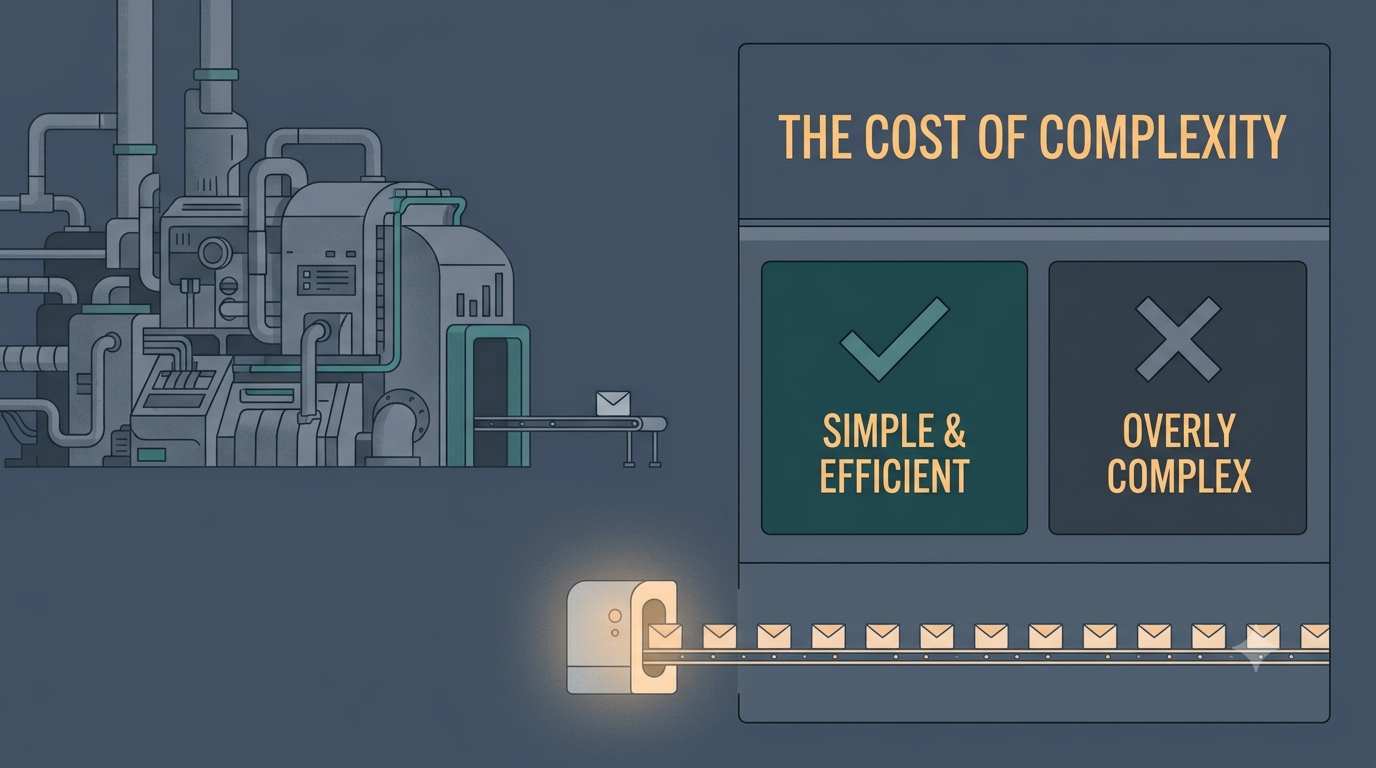
The "95% of AI pilots fail" statistic is misquoted, but the real numbers are not much more comforting. Gartner expects over 40% of agentic AI projects to be canceled by 2027, and the average organization scraps nearly half its proofs of concept before production. The reasons are predictable, rarely technical, and worth understanding before you approve the next phase of yours.
The Statistic Everyone Quotes and Almost Nobody Read
In late 2025, a single number from an MIT research initiative went everywhere: 95% of enterprise AI pilots fail. It appeared in board decks, LinkedIn posts, conference keynotes, and more than a few sales pitches from vendors promising to put you in the other 5%.
Here is what the report actually found. MIT's NANDA initiative, in its "GenAI Divide" study, concluded that around 95% of enterprise generative AI pilots produced no measurable impact on profit and loss, and that only about 5% achieved rapid revenue acceleration. That is not the same claim as "95% fail." A pilot that saves a support team ten hours a week but never registers in company-level earnings is invisible to that methodology. It did not fail. It just never scaled far enough to matter financially.
The distinction is worth making because this article is going to lean on failure statistics, and the field is full of numbers that fall apart when you trace them to the source. So here are the ones that hold up.
Gartner forecasts that over 40% of agentic AI projects will be canceled by the end of 2027, citing escalating costs, unclear business value, and inadequate risk controls. S&P Global Market Intelligence found that the average organization scrapped 46% of its AI proofs of concept before they reached production, and that 42% of companies abandoned most of their AI initiatives in the past year, up from 17% the year before. McKinsey's research shows 88% of organizations now use AI in at least one function, while fewer than 10% have scaled AI agents to the point of delivering tangible value in any single function.
Read together, these numbers tell a consistent story, and it is not that AI does not work. It is that the transition from a working demo to a working system is where projects die, and most organizations still budget, staff, and plan as if that transition were trivial.
The Demo Was Never the Hard Part
A pilot proves that a model can do the task. Once. With curated inputs, a motivated operator sitting next to it, and an audience that wants it to succeed.
Production requires the same task done thousands of times, unattended, against whatever the real world sends, with a named person accountable when the answer is wrong. These are two different engineering problems, and the second one is far larger than the first. The uncomfortable pattern in most failed projects is that budget was approved based on the economics of the first problem while the organization quietly expected the outcomes of the second.
The gap is not new. Any engineer who has shipped software knows the distance between "it ran on my machine" and "it runs for every customer." What is new is how deceptively small the gap looks with AI. A language model demo is genuinely impressive in a way a half-built web app never was. It talks. It handles the curveball question the CFO throws at it. It feels finished. That feeling is precisely what makes the pilot stage so dangerous: the demo does the best sales job of any demo in the history of enterprise software, for a system that might be 20% built.
A pilot tells you about capability. It tells you almost nothing about reliability, about cost per task at real volume, about what happens when the input data shifts, or about who fixes it at 2 a.m. when it starts confidently giving customers wrong answers. Those are the questions production asks, and a demo cannot answer any of them.
The Four Ways Pilots Actually Die
Across the failure research and across the projects we have been brought in to rescue, the causes cluster into four patterns. None of them are about model quality.
Nobody defined what success meant
Root-cause analyses of failed agent deployments consistently rank unclear success criteria as the leading cause, ahead of data problems and well ahead of anything technical. The symptom is easy to recognize: three months into the pilot, ask five stakeholders whether it is going well and you get five different answers, because nobody agreed in advance which number the system was supposed to move.
"It works" is not a metric. "First-response time drops below two minutes and deflection reaches 40% without a drop in satisfaction scores" is a metric. Projects with the first kind of goal get judged on vibes, and vibes shift with every anecdote about a wrong answer. Projects with the second kind survive their bad weeks, because a bad week shows up as a number to investigate rather than a story that spreads.
The data was never ready
Gartner projects that 60% of AI projects unsupported by AI-ready data will be abandoned through 2026. In practice, this failure looks mundane. The pilot ran against a clean export somebody prepared by hand. Production reads the actual CRM, with its duplicate contacts, stale fields, inconsistent tags, and the custom field that means something different depending on which team filled it in.
The agent then gets blamed for the database's sins. It routes a lead wrong because the source field was wrong. It quotes an old price because three versions of the price sheet exist and nobody marked one canonical. Leadership concludes the AI is unreliable, when the honest conclusion is that the AI faithfully reflected an unreliable data layer that humans had been quietly compensating for over years.
No one owned it after launch
Pilots have champions. Production systems need owners, and these are not the same role. A champion supplies enthusiasm, executive sponsorship, and momentum. An owner has the system's KPI in their performance goals, holds the budget for its upkeep, and answers for it when it misbehaves.
The predictable failure sequence: the champion gets the pilot approved, the pilot succeeds, the champion is promoted or moves on, and the system enters a state where everyone uses it and no one maintains it. Prompts go stale. An API changes. Accuracy drifts down a few points a month. A year later someone asks why "that AI thing" is worse than it used to be, and the answer is that no human being was ever assigned to notice.
There was no way to know it was degrading
A model that performs well at launch does not necessarily perform well at day ninety. Input mix shifts as new customer segments arrive. Providers update models behind stable API names. Small quality declines compound invisibly. Without evaluation infrastructure, the first detector of a regression is a customer, and by the time complaints surface, trust in the system has already taken damage that no fix fully repairs.
This is an engineering discipline in its own right, and we covered it in depth in [Why Your LLM Works in the Demo and Breaks in Production](https://nexhubai.com/insights/llm-production-failure-lessons). The decision-maker's version is one sentence: if nobody can tell you how you would know the system got worse, it is not a production system. It is a demo that has been left running.
Two Public Reversals Worth Studying
Genuine postmortems are rare because companies bury failed AI projects quietly. Two cases played out in public, and both are more instructive than the headlines suggested.
Klarna announced in early 2024 that its AI assistant was doing the work of roughly 700 customer service agents, and the claim became the poster child for AI replacing support teams. Within about a year, the company publicly changed course. CEO Sebastian Siemiatkowski acknowledged that making cost the dominant factor had produced lower-quality service, and Klarna began recruiting human agents again. The lesson is not that support AI failed. Klarna still automates a large share of its volume. The lesson is that scope was set by ambition rather than by evidence, and the correction was expensive and public.
Air Canada's case is smaller and sharper. Its website chatbot invented a bereavement fare policy that did not exist, a customer relied on it, and in 2024 a Canadian tribunal ordered the airline to honor what its bot had promised. Air Canada had argued the chatbot was a separate entity responsible for its own statements. The tribunal disagreed. The precedent is the point: accountability does not transfer to the bot. Whatever your system tells a customer, you said it.
One more observation from researching this piece. While gathering cases, we came across circulating roundups of dramatic 2026 "AI agent disasters," complete with incident details, damage figures, and citations to major news outlets. We could not trace a single one to the outlets supposedly cited. Fabricated case studies, plausibly AI-generated, are now part of the content landscape around AI failures themselves. If a story or statistic cannot be followed to a primary source, treat it as marketing. That rule is half the reason this article cites as few numbers as it does.
What the Survivors Have in Common
The deployments that make it out of pilot are consistently less ambitious and more disciplined than the ones that die.
They start narrow. Across McKinsey's function-level data, the workflows that convert to scaled production first are the bounded, high-volume, unglamorous ones: ticket triage, document processing, internal search, operations coordination. High volume makes results measurable quickly. Bounded scope makes failure modes enumerable. There is a reason nobody's first production success is "an agent that runs the company," a pattern we examined from the enterprise side in [Multi-Agent AI Is Redefining How Enterprises Operate in 2026](https://nexhubai.com/insights/multi-agent-ai-enterprise-2026).
They have an owner with a number. One person can state the metric the system exists to move, report it monthly, and gets asked about it when it slips.
They gate changes on evaluation. No prompt edit or model swap ships without being tested against a fixed set of real examples with known correct outputs. This sounds like process overhead. It is the single cheapest insurance in the entire stack.
And they redesign the workflow around the system instead of bolting the system onto the workflow. An agent inserted into a broken process produces a faster broken process. The teams that get results treat the AI project as an operations project that happens to involve AI, which is roughly the thesis of our [practical guide for service businesses](https://nexhubai.com/insights/ai-automation-practical-guide-service-businesses).
None of this is visionary. That is the point. The 5% are not smarter. They are more boring, earlier.
Five Questions Before You Approve the Next Phase
If you have a pilot heading toward a scale-up decision, five questions will tell you more than any vendor deck. They fit in one meeting.
What number moves if this works, and by how much? Who owns that number after launch, by name? What data will production touch that the pilot never saw? What happens, specifically, when the system is wrong in front of a customer? And how would we know it got worse next quarter?
If any answer is a shrug, the project is not ready to scale, and discovering that in a meeting costs a great deal less than discovering it in production. A stalled pilot with clear answers to these questions is usually fixable. A smooth pilot with none of them is the one the cancellation statistics are made of.
Frequently Asked Questions
Do 95% of AI pilots really fail?
No. The figure comes from MIT's GenAI Divide study, which found that about 95% of enterprise generative AI pilots showed no measurable profit-and-loss impact and roughly 5% achieved rapid revenue acceleration. Many pilots in the 95% delivered real local value that simply never scaled to company-level financials. The defensible summary is that most pilots stall before producing business-level results, not that most AI does not work.
How long should an AI pilot run before a scale-or-kill decision?
Long enough to produce a statistically honest read on the one metric it was designed to move, which for high-volume workflows is usually 60 to 90 days. Pilots that run past six months without a decision are typically not still being evaluated. They are being avoided.
Should we cancel a stalled pilot or try to fix it?
Diagnose before deciding. If the stall traces to unclear success criteria, missing ownership, or dirty data, those are fixable and usually cheaper to fix than starting over. If the stall traces to the use case itself, meaning low volume, unbounded scope, or no measurable outcome, cancellation is the correct and underused option. Gartner's cancellation forecast is not entirely a story of failure; some of those cancellations are organizations correctly cutting losses.
What is the actual difference between a pilot and a production system?
A pilot demonstrates capability under controlled conditions. A production system adds reliability under real conditions: defined success metrics, a named owner, data pipelines that handle real inputs, evaluation gates on every change, monitoring that detects degradation, and a plan for what happens when the system is wrong. If those elements are missing, what is running is a long-lived demo, whatever the org chart calls it.
Start with your requirements
Our AI assessment identifies your highest-value automation opportunities in 30 minutes.
Free Assessment